Active Reading Techniques
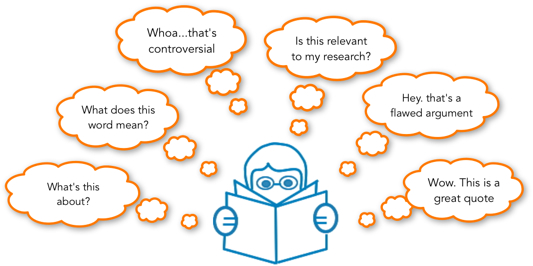
Do you always understand everything you are reading? I know I don´t. Therefore, I must engage in active reading techniques, EVEN in my own language, EVEN as an adult.
The only way for us to become better readers and to learn more thoroughly, is to engage in active reading techniques. So, what does this look like?
Active Reading teaches us how to engage with the texts we are reading. Once we understand what we are reading, we can give purpose to this understanding. The more purpose we have, the better readers we become.
Below are ways to become a more ACTIVE READER:
First off, you ARE ALLOWED and encouraged to write about and sometimes even ON your reading materials. But what does this mean and what is it called?
Writing, asking questions, making comments about our own reading is called annotation. We can do this actively on our books or in our notebooks on the side. (note: If you aren´t annotating ON THE TEXT, remember to write down the page of the book you are writing about etc.) So, annotating can look many ways. We can ask a question, we can highlight a word, we can predict what we think the material in question means.
1. Ask Questions:
When we ask ourselves questions, why did the author use this title, how does the author organize the book or story etc…, we can look for the answers, which will in turn, give us more understanding of the text.
If we come across a difficult sentence, how can we interpret what it means? How can we break down the material to better understand it?
2. Practice multisyllabic reading:
learn how to break words apart to better understand them.
For example: unforgettable: un-for-get-able
3. Set a purpose for reading:
Why are you reading this information? What is it trying to tell you? Why is this information important? How can it better help you as a reader, or simply as a person?
4. Set a purpose WHILE reading:
after each paragraph, try to summarize why this paragraph or information was necessary to put into the text.
5. Learn non-fiction text structures:
A. Description
B. Problem Solving
C. Compare and Contrast
D. Cause and Effect
E. Sequence
6. Review important vocabulary
and the differences between vocabulary:
A. basic vocabulary words verses more advanced description etc.
7. Read around the word you do not know:
Read the entire sentences and the sentences before and after. Then try and find a synonym to use to replace that word.
8. Re-read your text:
A. read it aloud
B. follow along with your finger
9. Discuss your reading
with another person, either in your home or at school.
11. Extend your library!
At home or at school!!!!
Practice Active Reading Techniques:
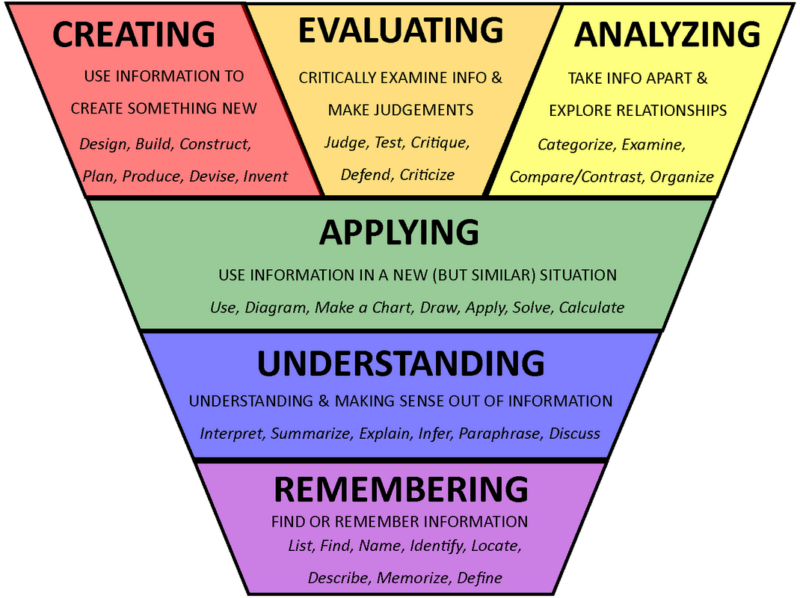
Below is a graph of how to improve your reading from the ground up (from the bottom to the top): Test yourself now with a piece of writing of your choice:
Can you list basic information about this text? The title, the author etc?
Can you summarize the text?
How can you apply the information? Can you simplify the information and put it into a van diagram?
How can you take this information and create something new?
Can you defend or criticize this information? Can you find critiques?
How can you analyze this information? Compare and contrast it with other pieces of writing?
Resources:
https://www.weareteachers.com/active-reading-strategies/
https://knilt.arcc.albany.edu/Unit_2:_Active_Reading_for_Comprehension